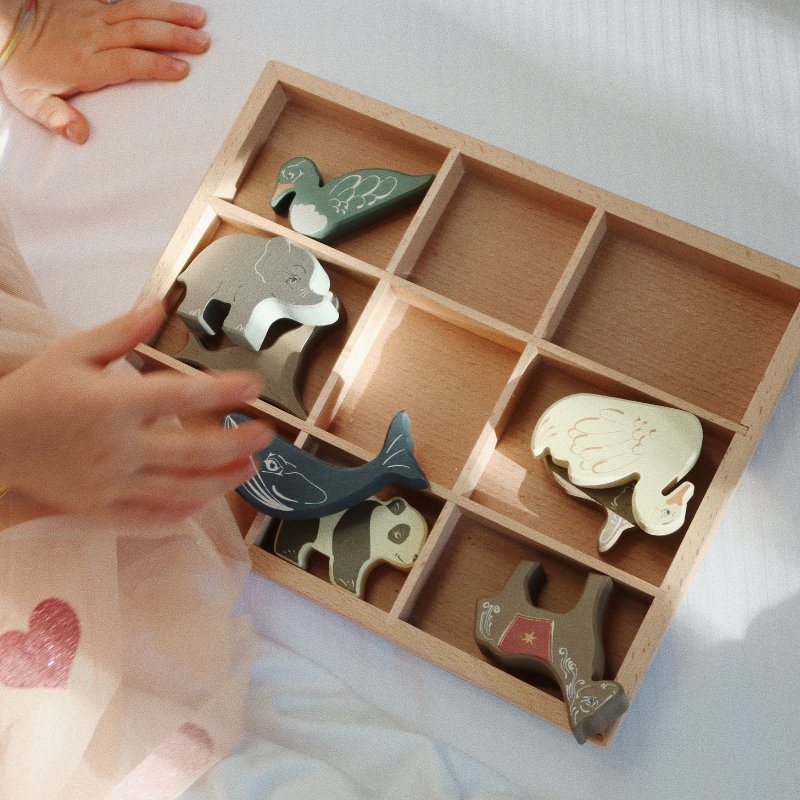
If you have been searching for toys for a child with color blindness, you already know the problem. Most product descriptions say nothing useful. “Bright colors” and “colorful design” appear everywhere, but no one tells you whether those colors actually work for a child who cannot distinguish red from green.
This article cuts through that. Here is what genuinely helps, what to avoid, and why high-contrast animal toys are one of the best places to start.
Why most toys fall short
The toy industry designs for the average child. Color is used as the primary way to differentiate pieces, indicate correct answers, and guide play. A puzzle where the red piece goes in the red slot. A game where the green player wins. A set of animal figures where the frog is green and the ladybird is red.
For a child with color vision deficiency, these toys do not just fail to engage, they actively create frustration. The child is not struggling because they are not trying. They are struggling because the toy was never designed with them in mind.
What makes a toy genuinely colorblind friendly
The best toys for colorblind kids share a few clear characteristics.
Shape does the heavy lifting. When a toy communicates through shape and form as much as color, a colorblind child can engage with it fully. Animal figures are a great example, a lion is recognizable by its mane and body shape, not just its color. An elephant by its trunk. A zebra by its stripes.
High contrast replaces color reliance. The most accessible color combinations for children with red-green color blindness are those that do not depend on distinguishing red from green at all. Deep blues, bright yellows, black outlines, and white backgrounds create visual clarity that works for every child.
Size and tactile feel add another layer. Small animal figures that fit in a child’s hand and have distinct physical forms give an additional way to identify and differentiate, touch, not just sight.
Clear, simple design wins over busy detail. Toys with too many visual elements become confusing when color differentiation is limited. Clean, bold, simple designs are always easier to read.
What to avoid
Toys that use red and green as the main differentiating colors are the most common problem. This includes many board games, sorting toys, and educational sets. If the entire point of the activity depends on telling red from green, it will not work well for a child with the most common form of color blindness.
Also worth avoiding are toys with very small, intricate details where color is the only way to distinguish one element from another. The more a toy relies on subtle color variation, the less accessible it is.
Why animal figures work so well
High contrast animal toys for children are one of the most naturally inclusive toy categories available. Each animal already has a distinct identity, shape, size, physical features, that exists entirely separately from color. A well-designed set of animal figures gives a colorblind child everything they need to learn, sort, name, and play independently.
For toddlers especially, small animal figures build vocabulary, encourage imaginative play, and develop fine motor skills without putting color recognition at the center of the experience. The win is in the naming, the holding, the storytelling, none of which require perfect color vision.
The bottom line
Inclusive toys for children with color vision deficiency are not a niche category. They are just well-designed toys. At Pink Unicorn, every animal figure is built around high-contrast colors and bold distinct shapes so your child can play, learn, and win on their own terms.